
If you’ve ever stood at the edge of a park, looking at the joggers gasping for air and the power-walkers casually chatting, you’ve probably asked yourself the million-dollar question: Walking vs running for weight loss—which one actually works?
For years, we’ve been told that if you aren’t drenched in sweat and pushing your heart rate to the limit, you aren’t really “working out.” It’s an intimidating thought that keeps many of us glued to the couch. After all, if the only path to fitness is a grueling five-mile run, it’s easier to just not start.
But here is the secret: your body doesn’t care about the labels. It cares about movement, consistency, and how you fuel it. Whether you want to drop a dress size for a wedding or just want to feel lighter on your feet, choosing between these two depends more on your lifestyle than you might think.
In this deep dive, we’re going to settle the walking vs running for weight loss debate once and for all, looking at the science, the joints, and the reality of the “afterburn.”
Table of Contents
1. The Great Calorie Debate: Science Simplified
Let’s get the math out of the way first. When comparing walking vs running for weight loss, the most basic metric is the calorie.
Generally speaking, running burns roughly double the calories per minute compared to walking. If you run at a steady pace for 30 minutes, you might burn 300 to 400 calories. If you walk for that same 30 minutes, you might only hit 150.
The Intensity Factor
However, there is a catch. Most people can’t run for an hour every single day without burning out or getting injured. But almost everyone can walk for an hour.
When you look at it through the lens of sustainability, the gap starts to close. If walking allows you to stay active for 60 minutes while running leaves you exhausted after 15, which one is actually better for your long-term goals?
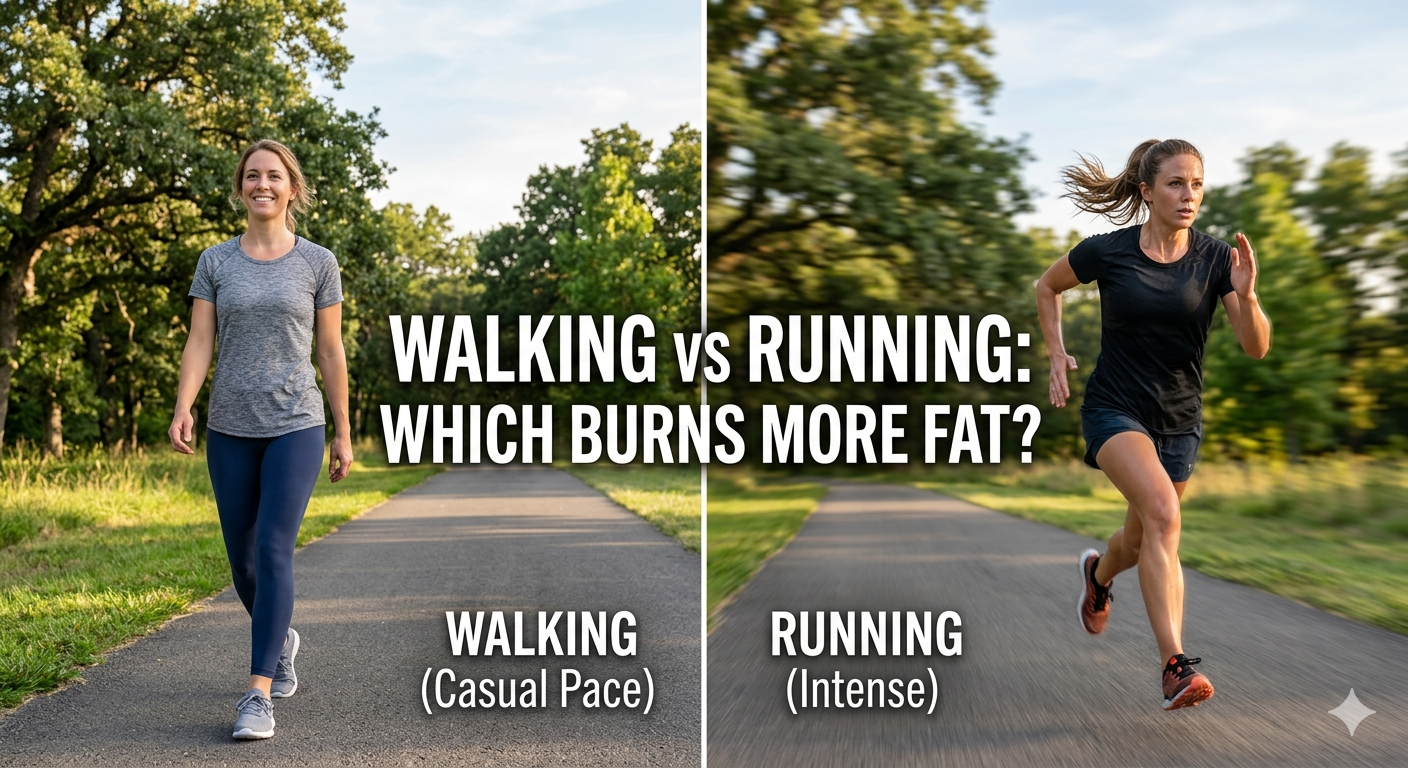
[Image Suggestion: A split screen showing a person in running gear and a person in comfortable walking clothes on a trail.]
Alt Text: Comparison of walking vs running for weight loss calories burned
2. Why Walking is the Secret Weapon for Fat Loss
Don’t sleep on walking. It is often the “unsung hero” of the fitness world. If you’re carrying a significant amount of extra weight, walking is actually the superior choice to start.
The Fat-Burning Zone
There’s a physiological sweet spot called the “Fat Burning Zone.” When you perform low-intensity steady-state (LISS) exercise—like brisk walking—your body primarily uses stored fat as fuel.
Lower Stress Levels
Running is a stressor. It spikes cortisol. For some people, high cortisol levels can actually make the body hold onto belly fat. Walking, on the other hand, lowers cortisol and reduces stress, making it a powerful tool for hormonal weight loss.
3. The High-Octane Power of Running
If time is your biggest constraint, running is the undisputed king. It’s efficient. You can get a massive cardiovascular hit in just 20 minutes.
Cardiovascular Health
Running strengthens the heart more aggressively than walking. It improves your $VO_2$ max (the maximum amount of oxygen your body can use during exercise) much faster.
Appetite Suppression
Interestingly, some studies suggest that high-intensity exercise like running can temporarily suppress ghrelin—the “hunger hormone.” This means you might find it easier to stick to your diet after a run than after a long walk that leaves you “famish-ly” hungry.
4. Joint Health: Longevity vs. Intensity
This is where the walking vs running for weight loss debate gets personal. Every time your foot hits the pavement while running, your joints absorb a force equal to about 3x your body weight.
- Walking: Low impact. It’s gentle on the knees, hips, and ankles. It’s something you can do well into your 80s.
- Running: High impact. While it can actually strengthen bone density, it requires proper form and expensive shoes to avoid shin splints or runner’s knee.
If you have a history of joint pain, walking isn’t just an alternative; it’s the smarter strategy.
5. Walking vs Running for Weight Loss: The Afterburn Effect
In the fitness world, we call this EPOC (Excess Post-exercise Oxygen Consumption). Basically, it’s the calories your body continues to burn after you’ve finished your workout.
Running creates a much higher “afterburn” than walking. Your body has to work harder to return to its resting state, repair muscle fibers, and cool down. This means you’re still burning calories while you’re sitting on the couch watching Netflix after a run.
Walking has almost zero afterburn. Once you stop moving, the calorie burning pretty much stops too.
6. Step-by-Step Guide: Starting from Scratch
Whether you choose walking vs running for weight loss, you need a plan. Don’t just go out and “wing it.”
The “Walk-to-Run” Transition Plan
- Week 1: Walk for 30 minutes, 5 days a week. Focus on a brisk pace (like you’re late for a bus).
- Week 2: Add “Power Intervals.” Walk 4 minutes, then walk as fast as you possibly can for 1 minute. Repeat 6 times.
- Week 3: Introduce the 30-second jog. Walk 4 minutes, jog 30 seconds.
- Week 4: Half and half. Jog for 2 minutes, walk for 2 minutes.
By slowly increasing the intensity, you get the calorie-burning benefits of running without the “I want to quit” feeling of Day 1.
7. Real-Life Success Stories
Take Mike, a 45-year-old accountant. He tried running and quit three times because his shins hurt. He switched to “Incline Walking” (walking on a treadmill at a steep hill). He burned nearly as many calories as a jogger but without the pain. He lost 30 pounds in 6 months.
Then there’s Sarah. She needed the “runner’s high” to stay motivated. She used a “Couch to 5K” app and found that the mental discipline of running helped her stop stress-eating at night.
Both achieved their goals. The “best” method was the one they actually stuck with.
8. Common Mistakes That Kill Progress
- The “I Earned This” Cookie: Burning 300 calories on a run doesn’t justify a 600-calorie muffin. You cannot out-run a bad diet.
- Ignoring Strength Training: Both walking and running can lead to muscle loss if you aren’t eating enough protein or lifting weights.
- Static Stretching Beforehand: Never stretch “cold” muscles. Do a dynamic warmup (leg swings, arm circles) instead.
- Same Routine Every Day: Your body is smart. It adapts. If you walk the same path at the same speed every day, you’ll eventually plateau.
9. FAQs
Can I lose belly fat just by walking?
Yes! Walking is excellent for reducing visceral fat (the dangerous fat around your organs), especially when combined with a calorie deficit.
Is 10,000 steps a day enough to lose weight?
It’s a great start, but it depends on what you’re eating. 10,000 steps is roughly 5 miles, which burns about 400-500 calories.
Does walking on an incline burn more than running flat?
Often, yes! Walking at a 10% incline at 3.5 mph can burn as many calories as running at 5 mph on a flat surface, with much less impact on your knees.
What shoes should I buy?
Go to a dedicated running store. Even if you’re just walking, they can analyze your gait to see if you overpronate. The wrong shoes are the #1 cause of injury.
Should I do cardio before or after weights?
If weight loss is the goal, do weights first. Use your fresh energy to lift, then use walking or running to “empty the tank” at the end.
10. Conclusion: Which is Best for You?
So, who wins the battle of walking vs running for weight loss?
If you are a beginner, have joint issues, or want something you can do every single day without fail, walking is your winner. It is sustainable, therapeutic, and incredibly effective at burning fat.
If you are short on time, love a challenge, and want to improve your cardiovascular fitness quickly, running is the way to go.
The most successful people usually do a mix of both. Walk on your recovery days, and run when you feel like a powerhouse. The only “wrong” choice is staying on the couch.
Ready to start? Put on your sneakers right now and go for a 15-minute brisk walk. Don’t think about it—just do it. Your future self will thank you.